Introduction
Choosing the right software is one of the most important technology decisions a business can make. Whether you are a startup, a growing enterprise, or an established organization, the software you use directly impacts productivity, efficiency, customer satisfaction, and long-term growth.
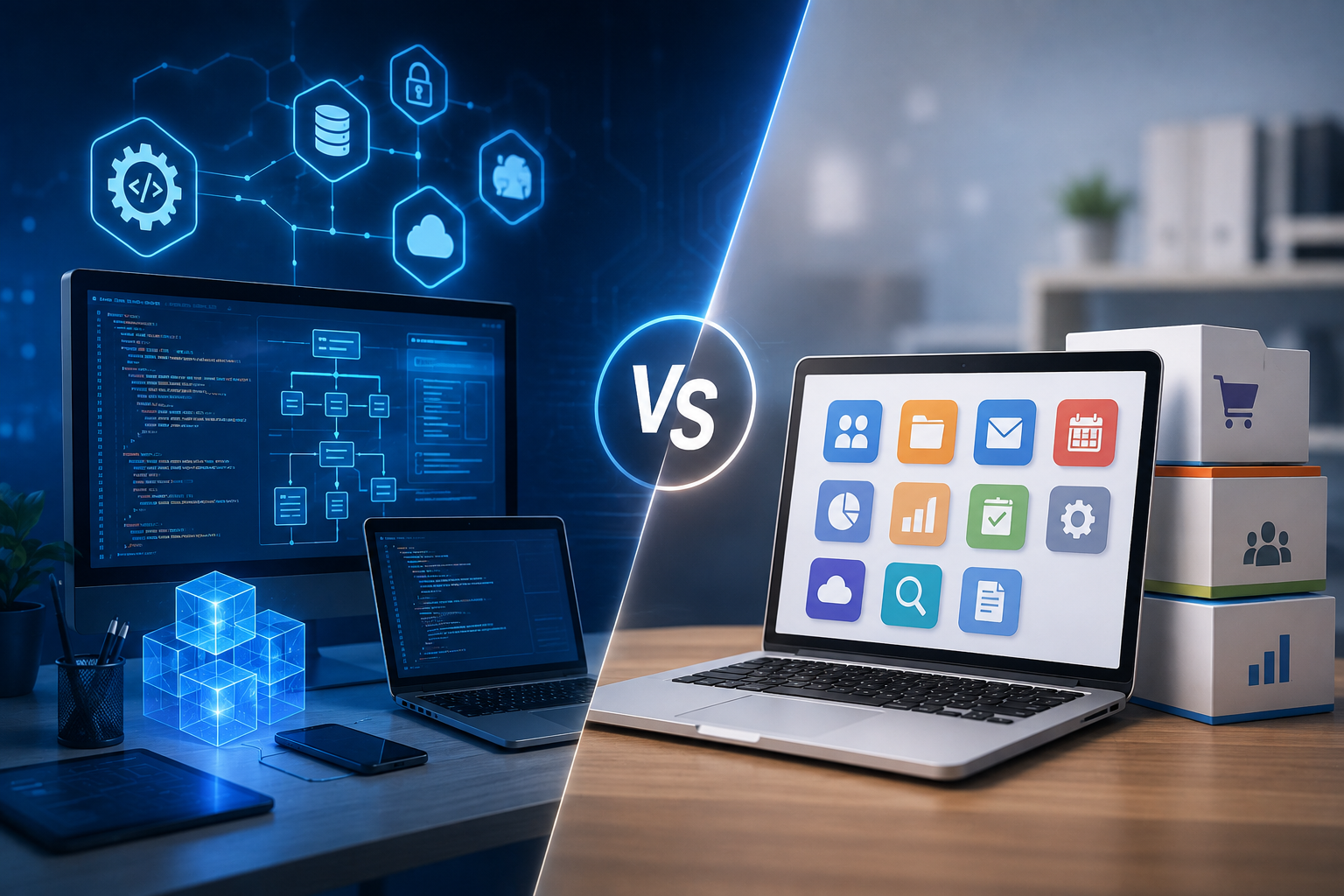
Businesses today generally have two options: Custom Software developed specifically for their unique requirements, or Off-the-Shelf Software, which is pre-built and designed to serve a broad range of users. While both options have their strengths, selecting the right solution depends on your business goals, budget, scalability needs, and operational complexity.
This article explores the differences between custom software and off-the-shelf software, their advantages and disadvantages, and how to determine which solution is best suited for your organization.
What is Custom Software?
Custom software is a solution specifically designed, developed, and maintained to meet the unique requirements of a particular organization. Unlike generic software products, custom applications are built around your business processes, workflows, and objectives.
Examples include:
- Enterprise Resource Planning (ERP) systems
- Customer Relationship Management (CRM) platforms
- Inventory Management Systems
- Hospital Management Systems
- Learning Management Systems
- E-commerce platforms
- Mobile applications
- Business automation tools
Custom software evolves alongside your business and can be enhanced as your requirements change.
What is Off-the-Shelf Software?
Off-the-shelf software is a ready-made application developed for a wide audience and sold to multiple customers. These solutions are immediately available and often include standard features that meet common business needs.
Popular examples include:
- Microsoft Office
- Google Workspace
- Adobe Creative Cloud
- QuickBooks
- Zoom
- Slack
- Trello
- Shopify
These products are typically subscription-based or licensed and can be deployed quickly with minimal customization.
Key Differences Between Custom Software and Off-the-Shelf Software
| Feature | Custom Software | Off-the-Shelf Software |
|---|---|---|
| Development | Built specifically for one business | Developed for a broad market |
| Cost | Higher initial investment | Lower upfront cost |
| Implementation | Takes longer to develop | Ready to use immediately |
| Customization | Fully customizable | Limited customization |
| Scalability | Highly scalable | Depends on vendor capabilities |
| Integration | Designed to integrate with existing systems | May require additional connectors or workarounds |
| Ownership | Owned by the business (depending on the agreement) | Owned by the software vendor |
| Competitive Advantage | Provides unique business capabilities | Available to competitors as well |
| Maintenance | Managed by the development team or business | Managed by the software vendor |
Advantages of Custom Software
1. Tailored to Your Business Needs
Every organization has unique workflows and operational requirements. Custom software is designed specifically to support these processes, eliminating unnecessary features while providing exactly what your business needs.
2. Greater Flexibility
Custom software can easily adapt as your business grows.
You can:
- Add new modules
- Expand functionality
- Integrate new technologies
- Modify workflows
- Support changing business requirements
This flexibility makes custom software ideal for organizations planning long-term growth.
3. Better Integration
Businesses often use multiple applications for accounting, CRM, inventory, HR, and customer support.
Custom software can seamlessly integrate with:
- ERP systems
- Payment gateways
- Cloud platforms
- APIs
- IoT devices
- AI-powered applications
- Business Intelligence tools
This reduces manual work and improves operational efficiency.
4. Improved Security
Since custom software is built specifically for your organization, it offers greater control over security policies.
Organizations can implement:
- Role-based access control
- Multi-factor authentication
- Data encryption
- Audit logging
- Secure APIs
- Compliance requirements
Custom software reduces exposure to vulnerabilities commonly targeted in widely used commercial applications.
5. Competitive Advantage
Custom software enables businesses to develop unique capabilities that competitors using standard software cannot easily replicate.
Examples include:
- Personalized customer experiences
- Automated workflows
- AI-driven recommendations
- Industry-specific functionality
- Unique reporting systems
These features can improve efficiency and create long-term business differentiation.
Disadvantages of Custom Software
Despite its benefits, custom software also has certain challenges.
Higher Initial Cost
Custom development requires investment in planning, design, development, testing, deployment, and maintenance.
Longer Development Time
Depending on complexity, development may take several weeks or months before deployment.
Ongoing Maintenance
The organization or development partner is responsible for updates, bug fixes, security patches, and future enhancements.
Advantages of Off-the-Shelf Software
1. Lower Initial Investment
Ready-made software generally requires a lower upfront investment compared to custom development.
Most vendors offer:
- Monthly subscriptions
- Annual licenses
- Cloud-based pricing
- Pay-as-you-go models
This makes it attractive for startups and small businesses.
2. Quick Deployment
Businesses can begin using off-the-shelf software almost immediately after purchase.
There is no lengthy development process, allowing organizations to improve productivity quickly.
3. Vendor Support
Most commercial software providers offer:
- Technical support
- Regular updates
- Security patches
- Documentation
- Training resources
This reduces the burden on internal IT teams.
4. Proven Reliability
Popular software products have been tested by thousands or millions of users.
This often results in:
- Stable performance
- Mature features
- Extensive documentation
- Large user communities
Disadvantages of Off-the-Shelf Software
Limited Customization
Businesses may need to change their workflows to fit the software instead of the software adapting to the business.
Unnecessary Features
Commercial software often includes features that organizations never use, increasing complexity and reducing efficiency.
Subscription Costs
Although initial costs are lower, recurring subscription fees can become expensive over time, especially for growing organizations.
Vendor Dependency
Businesses depend on vendors for:
- Pricing
- Feature updates
- Product availability
- Technical support
- Licensing policies
Unexpected changes can affect operations.
When Should You Choose Custom Software?
Custom software is the best choice when:
- Your business has unique workflows.
- Competitive differentiation is important.
- You need advanced security and compliance.
- Existing software cannot meet your requirements.
- Long-term scalability is a priority.
- Multiple system integrations are required.
- You want complete control over features and future development.
When Should You Choose Off-the-Shelf Software?
Off-the-shelf software is suitable when:
- Your requirements are standard.
- You have limited development budgets.
- Quick implementation is essential.
- Minimal customization is acceptable.
- Vendor support is preferred.
- The software addresses common business needs effectively.
Cost Comparison
Custom Software
Initial Cost: High
Recurring Cost: Moderate (maintenance and upgrades)
Long-Term Value: High due to ownership, scalability, and tailored functionality.
Off-the-Shelf Software
Initial Cost: Low
Recurring Cost: Monthly or annual subscription fees
Long-Term Value: Varies depending on licensing, customization limits, and business growth.
Over several years, subscription costs for commercial software may equal or exceed the investment required for a custom solution.
Future Trends in Business Software
The software landscape continues to evolve with emerging technologies such as:
- Artificial Intelligence (AI)
- Machine Learning
- Cloud-native applications
- Low-code and no-code platforms
- Robotic Process Automation (RPA)
- Internet of Things (IoT)
- Blockchain integration
- Predictive analytics
- Generative AI assistants
Modern custom software increasingly incorporates these technologies to deliver intelligent automation and personalized user experiences.
How TEQZen Can Help
At TEQZen, we specialize in designing and developing secure, scalable, and high-performance software solutions tailored to your business objectives. Our expertise includes:
- Custom Software Development
- Web Application Development
- Mobile App Development
- Enterprise Software Solutions
- Cloud Application Development
- AI and Machine Learning Integration
- API Development and Integration
- Business Process Automation
- Software Modernization
- Ongoing Maintenance and Support
Whether you need a completely custom platform or guidance on selecting the right software solution, our team works closely with you to build technology that drives measurable business outcomes.
Conclusion
Both custom software and off-the-shelf software have their place in today's business environment. Off-the-shelf solutions are ideal for organizations seeking quick deployment, lower upfront costs, and standardized functionality. In contrast, custom software provides unmatched flexibility, scalability, integration capabilities, and long-term strategic value.
The right choice depends on your organization's size, goals, budget, and operational needs. If your business relies on unique workflows, requires seamless integration, or aims to gain a competitive edge, investing in custom software can deliver significant returns over time.
By carefully evaluating your current challenges and future growth plans, you can select a software solution that not only meets today's requirements but also supports tomorrow's success.
Frequently Asked Questions (FAQs)
1. Is custom software more secure than off-the-shelf software?
Custom software often offers enhanced security because it is designed specifically for your organization, allowing tailored security controls and compliance measures.
2. Is off-the-shelf software suitable for startups?
Yes. Startups with standard business needs and limited budgets often benefit from the quick deployment and lower initial cost of off-the-shelf software.
3. Can custom software integrate with existing systems?
Yes. One of the biggest advantages of custom software is its ability to integrate seamlessly with ERP systems, CRMs, payment gateways, cloud platforms, and third-party APIs.
4. Which option is more cost-effective in the long run?
While custom software typically requires a higher initial investment, it can provide better long-term value by eliminating recurring licensing fees and adapting to evolving business needs.
5. How long does custom software development take?
The timeline depends on the project's complexity, features, and scope. Small applications may take a few weeks, while enterprise-grade solutions can take several months.