
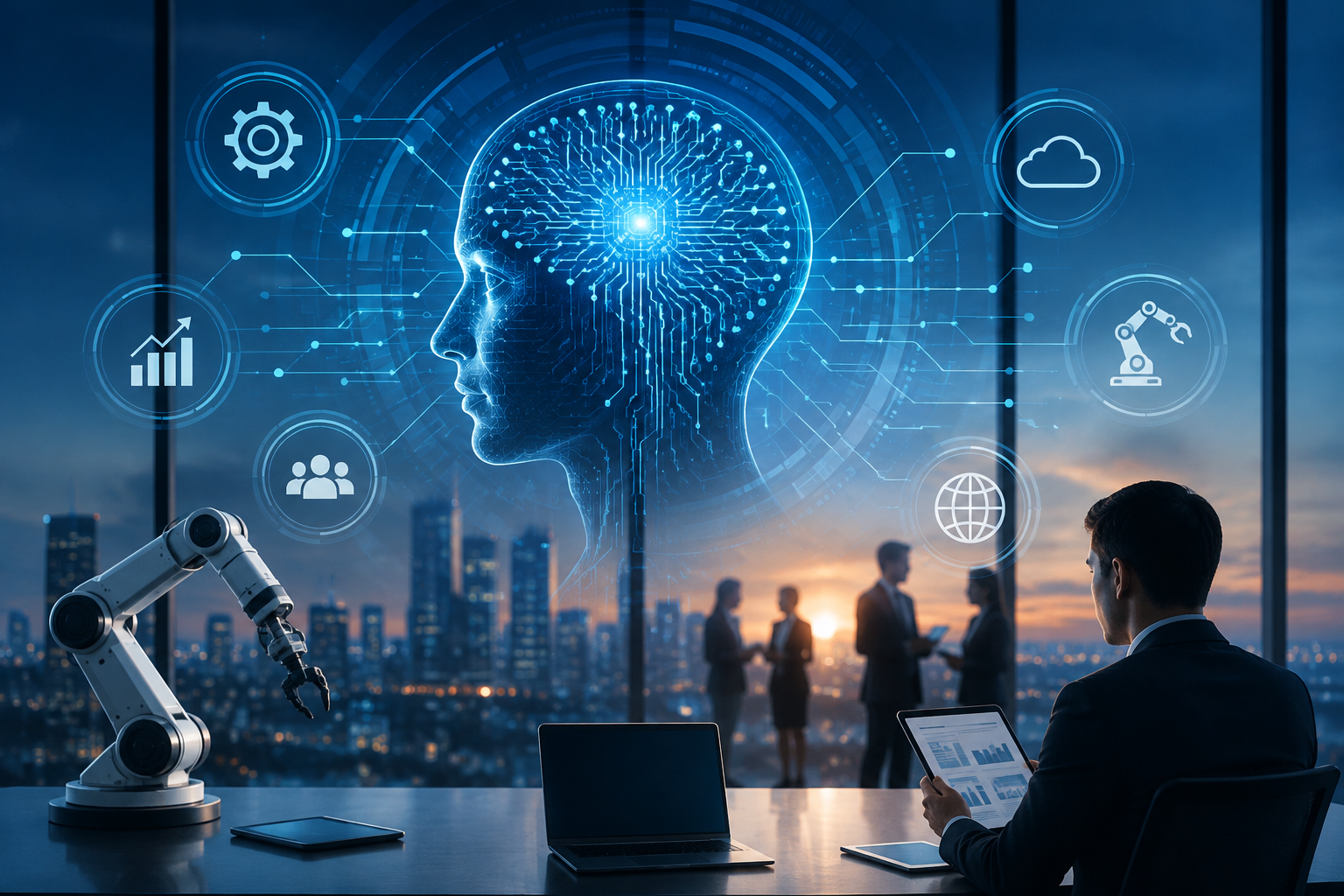
Introduction
Artificial Intelligence (AI) has evolved from an emerging technology into a fundamental business enabler. In 2026, organizations across industries are leveraging AI to automate repetitive tasks, enhance customer experiences, improve decision-making, and create innovative products and services. From startups to multinational enterprises, AI is no longer a luxury—it has become a strategic necessity for maintaining competitiveness in an increasingly digital world.
Businesses are integrating AI into everyday operations, enabling faster processes, reduced operational costs, improved accuracy, and better customer engagement. As AI technologies continue to advance, organizations that embrace intelligent automation are positioning themselves for sustainable growth and long-term success.
What is Artificial Intelligence?
Artificial Intelligence refers to the ability of computer systems to perform tasks that typically require human intelligence. These tasks include learning from data, recognizing patterns, understanding language, solving problems, making predictions, and supporting decision-making.
Modern AI encompasses several technologies, including:
- Machine Learning (ML)
- Deep Learning
- Natural Language Processing (NLP)
- Computer Vision
- Generative AI
- Robotic Process Automation (RPA)
- Predictive Analytics
Together, these technologies are reshaping how businesses operate and interact with customers.
Why AI Matters More Than Ever in 2026
Businesses generate massive amounts of data every day. Without intelligent systems, extracting meaningful insights from this data becomes difficult. AI enables organizations to analyze large datasets in real time, uncover trends, predict outcomes, and automate decision-making.
Key reasons why AI is becoming essential include:
- Increasing customer expectations for personalized experiences
- Growing demand for automation
- Rising competition across industries
- Need for faster business decisions
- Improved operational efficiency
- Enhanced cybersecurity requirements
Companies adopting AI today are better equipped to adapt to changing market conditions and customer needs.
Key Areas Where AI is Transforming Businesses
1. Intelligent Customer Support
AI-powered chatbots and virtual assistants provide instant responses to customer inquiries 24/7. These systems can handle thousands of interactions simultaneously, reducing response times while improving customer satisfaction.
Benefits include:
- Faster customer service
- Reduced support costs
- Improved customer engagement
- Multilingual assistance
- Personalized recommendations
2. Data-Driven Decision Making
AI analyzes historical and real-time data to identify business trends and forecast future outcomes.
Organizations use AI for:
- Sales forecasting
- Financial planning
- Demand prediction
- Risk assessment
- Business intelligence dashboards
Instead of relying solely on intuition, executives now make evidence-based decisions backed by AI-powered insights.
3. Business Process Automation
Routine administrative tasks consume valuable employee time. AI automates repetitive processes such as:
- Invoice processing
- Payroll management
- Data entry
- Document verification
- Inventory management
- Email categorization
Automation allows employees to focus on innovation, strategic planning, and customer relationships.
4. Personalized Customer Experiences
Consumers expect businesses to understand their preferences.
AI enables personalization through:
- Product recommendations
- Customized marketing campaigns
- Personalized email marketing
- Smart pricing strategies
- Individual customer journeys
Companies delivering personalized experiences often achieve higher customer satisfaction, stronger loyalty, and improved conversion rates.
5. Predictive Analytics
AI predicts future business events using historical data.
Applications include:
- Customer churn prediction
- Sales forecasting
- Equipment maintenance
- Fraud detection
- Inventory optimization
- Healthcare diagnostics
Predictive analytics helps organizations make proactive decisions rather than reacting after problems arise.
6. Cybersecurity Enhancement
Cyber threats continue to evolve rapidly.
AI strengthens cybersecurity by:
- Detecting unusual network activity
- Identifying malware
- Preventing phishing attacks
- Monitoring user behavior
- Responding to threats in real time
AI-powered security systems significantly reduce the risk of data breaches.
7. Smart Manufacturing
Manufacturing industries are embracing AI to improve production efficiency.
AI applications include:
- Predictive maintenance
- Automated quality inspection
- Robotics
- Supply chain optimization
- Production scheduling
These improvements reduce downtime while increasing product quality.
8. AI in Healthcare
Healthcare organizations are using AI to improve patient care.
Examples include:
- Disease diagnosis
- Medical image analysis
- Drug discovery
- Personalized treatment planning
- Hospital resource management
AI assists healthcare professionals by providing faster and more accurate clinical insights.
9. Financial Services
Banks and financial institutions rely on AI for:
- Fraud detection
- Credit scoring
- Automated customer service
- Investment recommendations
- Risk management
- Regulatory compliance
AI enables secure, efficient, and personalized financial services.
10. Human Resource Management
Human Resources departments increasingly use AI for:
- Resume screening
- Candidate matching
- Employee performance analysis
- Workforce planning
- Learning recommendations
This improves hiring efficiency and enhances employee development.
Benefits of AI for Modern Businesses
Organizations adopting AI experience numerous advantages, including:
- Increased productivity
- Reduced operational costs
- Faster decision-making
- Better customer experiences
- Improved accuracy
- Enhanced security
- Greater scalability
- Competitive advantage
- Innovation acceleration
- Higher profitability
Challenges of AI Adoption
Despite its advantages, businesses must address several challenges when implementing AI.
Data Privacy
AI systems require large volumes of quality data while complying with privacy regulations.
High Initial Investment
Developing AI solutions may require investments in infrastructure, software, and skilled professionals.
Skills Gap
Organizations often face shortages of AI engineers, data scientists, and machine learning specialists.
Ethical Concerns
Businesses must ensure fairness, transparency, accountability, and responsible AI usage.
Integration Complexity
Integrating AI with existing enterprise systems can be technically challenging.
Future AI Trends in Business
Several emerging trends are expected to shape AI adoption over the coming years.
Generative AI Expansion
Organizations will increasingly use generative AI for content creation, software development, customer support, and design.
AI-Powered Automation
More business operations will become autonomous through intelligent automation.
Explainable AI (XAI)
Organizations will prioritize AI systems that provide transparent and understandable decision-making processes.
Edge AI
Processing AI models closer to devices will improve speed, security, and reliability.
AI and IoT Integration
Smart devices connected through the Internet of Things will become increasingly intelligent using embedded AI.
Responsible AI
Businesses will focus on ethical AI development, bias reduction, data governance, and regulatory compliance.
How Businesses Can Successfully Implement AI
Organizations planning AI adoption should follow these best practices:
- Identify clear business objectives.
- Start with high-impact AI use cases.
- Invest in quality data management.
- Choose scalable AI technologies.
- Train employees on AI adoption.
- Monitor AI performance regularly.
- Ensure compliance with security and privacy regulations.
- Continuously optimize AI models.
A phased implementation strategy minimizes risks while maximizing business value.
Conclusion
Artificial Intelligence is redefining the way organizations operate in 2026. From automating repetitive tasks and enhancing customer engagement to enabling predictive analytics and strengthening cybersecurity, AI is helping businesses become more agile, efficient, and innovative.
Organizations that strategically embrace AI can improve operational performance, reduce costs, and deliver exceptional customer experiences while remaining competitive in a rapidly evolving digital landscape. As AI technologies continue to mature, businesses that invest in responsible adoption, workforce development, and continuous innovation will be well positioned to lead the next generation of digital transformation.
Whether you are a startup or an established enterprise, now is the time to explore how Artificial Intelligence can transform your business and create sustainable value for the future.